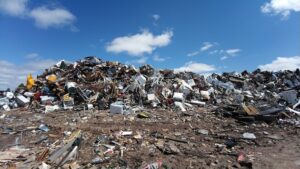
Vast amounts of valuable materials buried inside old batteries, electronic waste, and end-of-life vehicles should be collected for critical materials. Credit: FutuRaM
By Umar Manzoor Shah
SRINAGAR, India, May 27 2026 – Europe’s growing mountain of waste could become one of its most important sources of critical raw materials, according to a major new report that warns of rising geopolitical risks and growing global competition for minerals needed in the green and digital economy.
The report, released by the Horizon Europe-funded FutuRaM project, says Europe’s “urban mine” now contains vast amounts of valuable materials buried inside old batteries, electronic waste, end-of-life vehicles, construction debris and dismantled wind turbines.
Researchers behind the project say Europe must urgently improve recycling, recovery and tracking systems if it wants to reduce dependence on imported critical raw materials, many of which are dominated by a handful of countries.
“The FutuRaM project represents a substantial step forward in strengthening the knowledge base on secondary raw materials and CRMs within Europe’s urban mine,” the report states.
Kees Baldé, Senior Scientific Specialist, Sustainable Cycles at the United Nations Institute for Training and Research (UNITAR), told Inter Press Service (IPS) in an exclusive interview that the research mapped 42 Carbon-based Conductive Materials [CMS] in seven waste streams. It shows that the current substitution potential for primary materials in the final consumption of CRMs is a maximum of 27% overall.
“By 2050, the substitution potential could increase to over 50%. At the same time, 10 more than now (so, up to 24 different CRMs) could be sourced from the analysed waste streams. The new ones include rare earth elements found for instance in permanent magnets, such as Nd, Dy, Tb, Sm and Pr, but also Li, Co and Ce in batteries,” Baldé said.
The study comes at a time when European governments are racing to secure supplies of lithium, cobalt, nickel and rare earth elements used in electric vehicle batteries, wind turbines, solar panels and digital technologies.
Researchers said the project was developed amid “increasing geopolitical uncertainty, accelerating energy and digital transitions, and growing concerns regarding the security of supply of critical raw materials.”
When asked how vulnerable Europe is today when it comes to materials like lithium, cobalt and rare earth elements, Baldé said that most of them are sourced outside of the EU and supplied from single or only a few countries.
“Yet, they are critical for digitisation, renewable energy technology, and the military. Hence, they are on the critical raw material lists from the EU, and make the EU vulnerable.”
The report covers seven major waste streams, including waste batteries, construction and demolition waste, end-of-life vehicles, mining waste, slags and ashes, waste electrical and electronic equipment, and dismantled wind turbines.
One of the project’s key findings is that Europe still loses significant amounts of valuable materials because of weak collection systems, fragmented reporting rules and illegal waste flows.
“Persistent fragmentation of waste classifications, reporting systems and end-of-waste criteria across EU Member States undermines the functioning of the single market for secondary raw materials,” the report warns.
According to Baldé, the best sectors in terms of highest recovery rates and lowest tonnages of losses in tonnages are end-of-life vehicles and construction and demolition waste.
“Both have high collection rates and separate collection for some CRM rich components, such as Al and Cu. Despite this, there are still losses for several CRMs, such as rare earth metals, as indicated above. Biggest weaknesses in terms of tonnages of losses are industrial residues, such as slags and ashes,” Baldé said.
Using long-term modelling up to 2050, the project examined how different policies and recycling systems could affect future material recovery. Researchers developed three scenarios called business as usual, recovery, and circularity.
The report says improved recovery systems could significantly increase the amount of usable materials extracted from waste streams. Researchers also created a new recovery model that distinguishes between raw materials hidden inside waste and the materials that can actually be recovered after treatment.
Waste electrical and electronic equipment, commonly known as ‘e-waste’, has emerged as one of the most important future sources of valuable minerals. The study examined critical materials, including silver, gold, cobalt, gallium, neodymium, palladium and tungsten, found in electronic products.
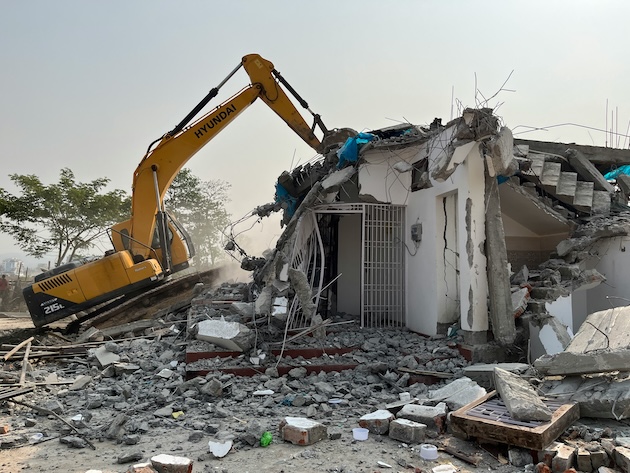
Construction and demolition waste has one of the highest rates of waste recovery. Credit: FutuRaM
The project also studied batteries in detail, focusing on materials such as lithium, cobalt, nickel, graphite and copper. Researchers looked at both current recycling technologies and future recovery systems.
At the same time, the report acknowledged major data gaps and uncertainty surrounding Europe’s waste streams.
“A comprehensive assessment of data quality is essential for ensuring that the conclusions and recommendations developed in FutuRaM are scientifically sound and fit for policymaking,” the report said.
Researchers noted that many datasets remain incomplete, commercially sensitive or inconsistent between countries. In some cases, industry data could only be used after anonymisation due to confidentiality concerns.
To improve transparency, the project developed a data quality framework based on six factors, including validity, accuracy, consistency, timeliness and completeness.
The project’s influence has already reached European policymakers. According to the report, FutuRaM worked closely with the European Commission and the Joint Research Centre to support implementation of the EU Critical Raw Materials Act.
“FutuRaM has provided data and intelligence to assist Member States in complying with this Article by identifying products, components and waste streams containing relevant CRMs,” the report states.
Researchers also carried out 20 case studies using a United Nations-based classification framework known as UNFC to assess the viability of recovery projects.
The project has drawn global attention beyond Europe. According to the report, FutuRaM findings were presented at 132 external events and conferences in countries including Singapore, Brazil, Thailand, Canada, Japan, Kenya and Panama.
A related report published for International E-Waste Day 2025 was picked up by almost 900 online news outlets across 55 countries and published in 27 languages.
“All actors that have access to and handle e-waste should report their activities for tracing purposes, while enforcement mechanisms and the role of authorities should be enhanced,” Pascal Leroy, Director General of the WEEE Forum, an international association representing global electronic waste producer responsibility organisations, told IPS News in an exclusive interview.
He said that we should also improve the infrastructure for e-waste management, along with making greater investments in relevant technologies.
“Additionally, awareness campaigns and proper funding are essential, and the Urban Mine Platform should be institutionalised. Finally, adherence to treatment standards must be made legally binding,” he said.
The researchers argue that Europe now needs stronger laws, standardised reporting systems and better recycling infrastructure to turn waste into a reliable strategic resource.
Among its recommendations, the report has pitched for a “harmonised European framework for classification, reporting, and life cycle tracking of secondary raw materials”.
It also urges European governments to strengthen enforcement against illegal waste exports, improve market surveillance and invest in recycling capacity and digital reporting systems.
“Supply from EU-recycling and demand from the EU-manufacturing industry need to be matched together,” Baldé said.
IPS UN Bureau Report
!function(d,s,id){var js,fjs=d.getElementsByTagName(s)[0],p=/^http:/.test(d.location)?’http’:’https’;if(!d.getElementById(id)){js=d.createElement(s);js.id=id;js.src=p+’://platform.twitter.com/widgets.js’;fjs.parentNode.insertBefore(js,fjs);}}(document, ‘script’, ‘twitter-wjs’);




 Saudi Riyal Exchange Rate